By Patricio V Marquez, Betty Hanan, Giovanni S Marquez
“Humanity does not have to live in a world of plagues, disastrous governments, conflict, and uncontrolled health risks. The coordinated action of a group of dedicated people can plan for and bring about a better future”
—William H. Foege, House on Fire: The Fight to Eradicate Smallpox, 2011
With the advent of 2021, the hope shared by the global community is that we can turn the page after the challenging year 2020 and reclaim some normalcy. The COVID-19 pandemic has disrupted and changed our lives in multiple ways, extracting a high human, social, and economic cost across the world.
In large measure, the emergency approval of the first COVID-19 vaccines (Pfizer/BioNTech and Moderna, and in the UK of AstraZeneca), and the promise of an additional pipeline of vaccines that may be approved in the upcoming months, is fueling this hope. But, as was anticipated, the massive deployment and administration of new vaccines for entire populations in countries is a complex task. It has encountered severe bottlenecks that are delaying the achievement of ambitious vaccination targets, even in rich countries such as the United States, the United Kingdom, and nations in the European Union.
While a crisis poses challenges, it also offers opportunities to learn and evolve. In that sense, perhaps we need to pause, look back, and learn anew from public health history to avoid being condemned to repeat past mistakes, by adapting methods that worked well in the past to deal with similar public health challenges.
Some of us have been blessed for having been exposed during our formative years to historical public health leaders such as Prof. D.H. Henderson, who led at the World Health Organization (WHO) the international effort to eradicate smallpox, before becoming the dean of the Johns Hopkins School of Hygiene and Public Health, and Dr. Ciro de Quadros, a Brazilian epidemiologist who was part of the smallpox eradication effort in Ethiopia and later led the Pan American Health Organization (PAHO)-driven polio eradication program in the Americas. Their work offers us some lessons that are highly relevant for ensuring that COVID-19 vaccination roll-out is effective.
- Lessons from the eradication of smallpox
More than 40 years have passed since the last naturally occurring case of smallpox, marking the “death of a disease.” This landmark global public health victory was the result of a 10-year smallpox eradication plan approved in 1966 by the World Health Assembly. It built upon the failed efforts over 1957-1975 to eradicate hookworm, yellow fever, yaws, and malaria.
The plan included two components: (i) systematic vaccination and (ii) a new concept—surveillance and containment. First, it called for continuous, routine collection of data about cases and deaths due to infectious diseases; the regular analysis and interpretation of this material; and its regular distribution to those responsible for disease control. Second, the containment of outbreaks by special containment teams required that vaccines be administered in the area where outbreaks were occurring, to break the chain of transmission by vaccinating possible contacts in areas where there were cases.
As explained by Prof. D.H. Henderson in an interview, an interesting historical aspect was that the plan was approved during the time that the Cold War between the US and the Soviet Union was at its peak. Both superpowers put aside their political differences to support and fund the smallpox eradication campaign. A lesson from this experience for successfully dealing with the ongoing COVID-19 pandemic, is that all countries should cooperate and participate in a global effort to control SARS-Cov2 under the technical lead of WHO and support from institutions such as the World Bank Group. This will require mobilizing financing resources to fund the vaccination effort at the country level, complemented by contributions from high income countries to COVAX to subsidize the purchase of vaccines for low-income and low-middle income countries under its Advance Market Commitment-92 (AMC-19) arrangement.
There are three additional lessons for the COVID-19 control effort that can be derived from the smallpox eradication experience, as recently highlighted in a Lancet commentary:
- well-defined, time-bound, programs need to be prepared and adopted, with clear, measurable objectives for extinguishing community transmission;
- equitable access and distribution of vaccines among countries, ramping up vaccine production, and ensuring quality control of laboratories making the vaccines;
- it is of critical importance to:
- undertake country vaccination readiness assessments to identify gaps in the system to inform policy and programmatic decisions;
- allocate adequate financial resources for strengthening logistical and operational capacity, including cold chain systems, to vaccinate entire populations in accordance with the results of the readiness assessments;
- have a cadre of well-trained personnel to administer the vaccines;
- involve local communities; and,
- support continuous research and feedback in the field.
- Lessons from Polio-Free Americas Program
The Americas was the first WHO region to be certified polio-free in 1994. This historical public health achievement in the region, was the product of work led by Dr. Ciro de Quadros between 1970 and 2002, serving as PAHO’s first head of the Expanded Program on Immunization (EPI).
The polio campaign in the Americas was launched in 1985, and the last case was reported in 1991. In accordance with EPI guidelines, the polio campaign was not run as an independent initiative but was part of an effort to integrate all programs for vaccine-preventable diseases. Thereby, national polio campaigns included other vaccines, such as measles, DPT, and tetanus toxoid.
Cuba provided the early signs that polio eradication was possible in the Americas. In 1962, Cuba launched a nationwide annual polio vaccination campaign with the oral polio vaccine (OPV) as part of a comprehensive national polio elimination program. The campaign and follow-ups, which targeted children 1 month – 14 years of age, with two doses given 4 weeks apart, and which were implemented twice a year, were characterized by high vaccination coverage achieved through week-long drives, surveillance of suspected cases, and outbreak investigation and control, when necessary. This strategy effectively halted polio transmission in Cuba, with the last case being recorded in May 1962.
The essential components of the polio-free effort in the Americas, that are highly relevant for the COVID-19 vaccination effort nowadays, were:
At the country level:
- Political will, local alliances, and community involvement are absolutely necessary to take on the goal of interrupting/controlling disease transmission. In the Americas, the regional campaign against polio was spearheaded by governments, international organizations, and nonprofits. As noted by Sir George Alleyne, the Director Emeritus of PAHO, the region became the first to defeat the once lethal childhood infection and has been able to sustain its infectious disease control programs since, because “the countries of the region accepted the need to eliminate polio and infectious diseases in general and there was commitment to a regional (Pan-American) approach to solving the problem.”
- In large measure, however, the success was due to the widespread support of local communities. For instance, in El Salvador, at the height of the country’s civil conflict in the mid-1980s, it was necessary that agreements be negotiated between the government and guerrilla forces, a painstaking process that involved PAHO, UNICEF, the Red Cross, and the Catholic Church, to observe cease-fires during national immunization days. Extraordinary social mobilization efforts accompanied the immunization campaigns, as well. Radio and television announcements and newspaper articles highlighted the importance of immunization, and people throughout Central America responded positively to these massive media campaigns.
- The number of staff responsible for the EPI, should be strengthened through additional human resources and training. The Plan of Action spearheaded by PAHO emphasized personnel training as a critical component of the program’s success. PAHO prepared training manuals and materials, and assisted countries with customizing these to fit the local context and circumstances. Training activities also bolstered the commitment of health workers and national governments towards the regional goal of polio eradication.
- High coverage, active surveillance, and lab networks are essential components for controlling disease outbreaks. Enhanced surveillance was a critical component for the success of this initiative, as inaccurate surveillance can hinder the timely implementation of early control measures. A reporting system with standard procedures and definitions was implemented to ensure that no cases were missed. Moreover, every case was regarded as a public health emergency and investigated immediately; its chain of transmission was used to determine the extent of virus circulation in the community. Increased laboratory support was critical since with the decrease in the number of cases and the increase in vaccination coverage, it became more important to determine if a poliovirus isolate was a wild virus. Gaps in the logistics required for collecting specimens and transporting them from the field to the laboratory were addressed. Laboratory support networks were created to analyze stool samples, and reference laboratories were established to provide more sophisticated tests, including genetic characterization of poliovirus isolates. PAHO immediately notified all countries of any outbreaks in the Americas so that traveler’s advisories could be issued.
- Conducting vaccination campaigns simultaneously and within a short period of time is beneficial to keep the momentum going, both for logistical and for immunity reasons. The main strategy for interrupting wild poliovirus transmission in the Americas was the implementation of National Immunization Days (NIDs) twice a year, targeting children less than 5 years of age with one dose of trivalent oral poliovirus vaccine (tOPV). This strategy was gradually replaced by regular immunization services performed routinely by health services.
- Involvement (or formation) of national interagency-coordination committees. Inter-agency, interinstitutional, and intersectoral cooperation arrangements that had been developed by prior health programs, were reorganized, repurposed, and applied on a broader scale for polio eradication. An Inter-agency Coordinating Committee (ICC) was established at the Regional level, to help organize the specific commitments of various members. The ICC included representatives from PAHO, UNICEF, US Agency for International Development, Inter-American Development Bank, Rotary International, and the Canadian Public Health Association. Many countries followed suit, establishing national ICCs to organize efforts at the national level. These institutional arrangements helped mobilize necessary support and the commitment of all actors involved and played an important role in mobilizing additional resources to complement existing resources at Ministries of Health. In addition to outside financial and technical resources, the community, organized community groups, and private voluntary organizations (e.g., Rotary International, religious groups, and mass media organizations) were leveraged to collaborate toward the goal. They assisted in promotional activities and distribution of supplies and provided personnel for vaccination activities.
At Global and Regional levels:
• Addressing public health emergencies of international concern requires international cooperation and support of partners to ensure that necessary resources and technical assistance are available to help national efforts.
• Global/Regional efforts need a high level of coordination among the countries and the international agencies. International agencies play an important role in advising and supporting national government efforts, as well in certifying sustained disease containment efforts in countries.
- Concluding Observations
The past and current experiences summarized above, offer clear lessons for rolling out COVID-19 vaccination across the world. While discussions on the merits of “vertical programs” versus “horizontal or integrated programs” has loomed in the background, it is clear that “diagonal approaches” work by prioritizing disease control and enhancing the capacity of health systems to effectively deal with public health crises.
Moving forward, equitable access and distribution of vaccines throughout the world needs to be guaranteed. This calls for coordination and solidarity among countries at the international level, supported by financial contributions to global mechanisms such as COVAX to subsidize the procurement of vaccines for low- and low-middle income countries.
Similar attention and effort need to be placed on the delivery of vaccines. As the global smallpox eradication and the polio-free Americas efforts showed, the development of a vaccine is not the end of the story. Rather, well-planned, organized, adequately funded, and delivered programs can protect people through vaccination, rapidly and relatively inexpensively if compared to the cost of treating people in intensive care units (ICUs) of hospitals and the indirect economic cost of ill health and lockdowns.
Global advocacy, coordination, and solidarity, as well as political support at the highest levels of government in countries, are critical to translate plans into sustained action to achieve clearly defined, measurable goals and targets. Trained, dedicated staff are required for a successful surveillance and disease control strategy. Innovative methods are needed to step up the vaccination drive, locating vaccination centers closer to where the population lives and works. Disease surveillance, prompt patient identification, diagnosis and isolation of all cases, contact tracing, and surveillance of contacts, supported by laboratory diagnostic capacity, are other critical actions. The future challenge will be to maintain the interruption of COVID-19 disease circulation over time.
Demand and uptake of vaccines is of upmost importance for vaccinating entire populations. Thus, sustained social mobilization to bring society together to trust and accept a new vaccine is an indispensable action. As the past experiences reviewed above have shown, non-partisan actors must be engaged to communicate with the public about the vaccine to address disinformation head-on. The polio vaccination experience in the United States, for example, evidenced that transparency, independence, and trust of “outside” organizations such as The March of Dimes helped overcome vaccine hesitancy. Also, the use of public figures, such as the singer Elvis Presley (the King of Rock ‘n’ Roll) getting one of the first shots of the polio vaccine on the TV set of the “The Ed Sullivan Show” in October 1956, inspired reluctant U.S. teens to get inoculated. In the conflict-riven Central America of the 1980s, the PAHO’s “Health as a Bridge for Peace” initiative, not only helped achieve one-day cease fires among combatants that were negotiated for polio vaccination, but supported the extraordinary social mobilization efforts that accompanied the immunization campaigns, as health workers at all levels sought to convince the population to take their children to health posts and special vaccination sites to be vaccinated. These lessons are of relevance nowadays given skepticism and distrust of governments in many countries globally. And, in some cases, government regulation may be a necessary tool nowadays to combat disinformation about COVID-19 vaccines being disseminated in social media channels.
To conclude, as we redouble our efforts to conquer COVID-19 in 2021, we will do well to keep in mind Dr. Ciro de Quadros’ observations:
“Until today I bring with me all the lessons of the smallpox eradication program: that you must have a clear goal, everyone needs to understand that goal, everybody must work together to achieve that, you must have permanent research and feedback to the field, and you must have the resources and political support. Those are the principles we brought to the Expanded Program on Immunization and that has been my experience throughout my public health career.”
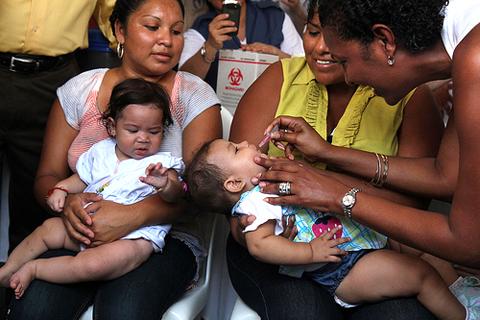
Source of Image: PAHO Revolving Fund vaccination days.
This article first appeared on pvmarquez.com: How to Defeat COVID-19? Some Lessons from the Global Smallpox Eradication and the Polio-Free Effort in the Americas | Patricio V. Marquez (pvmarquez.com)